


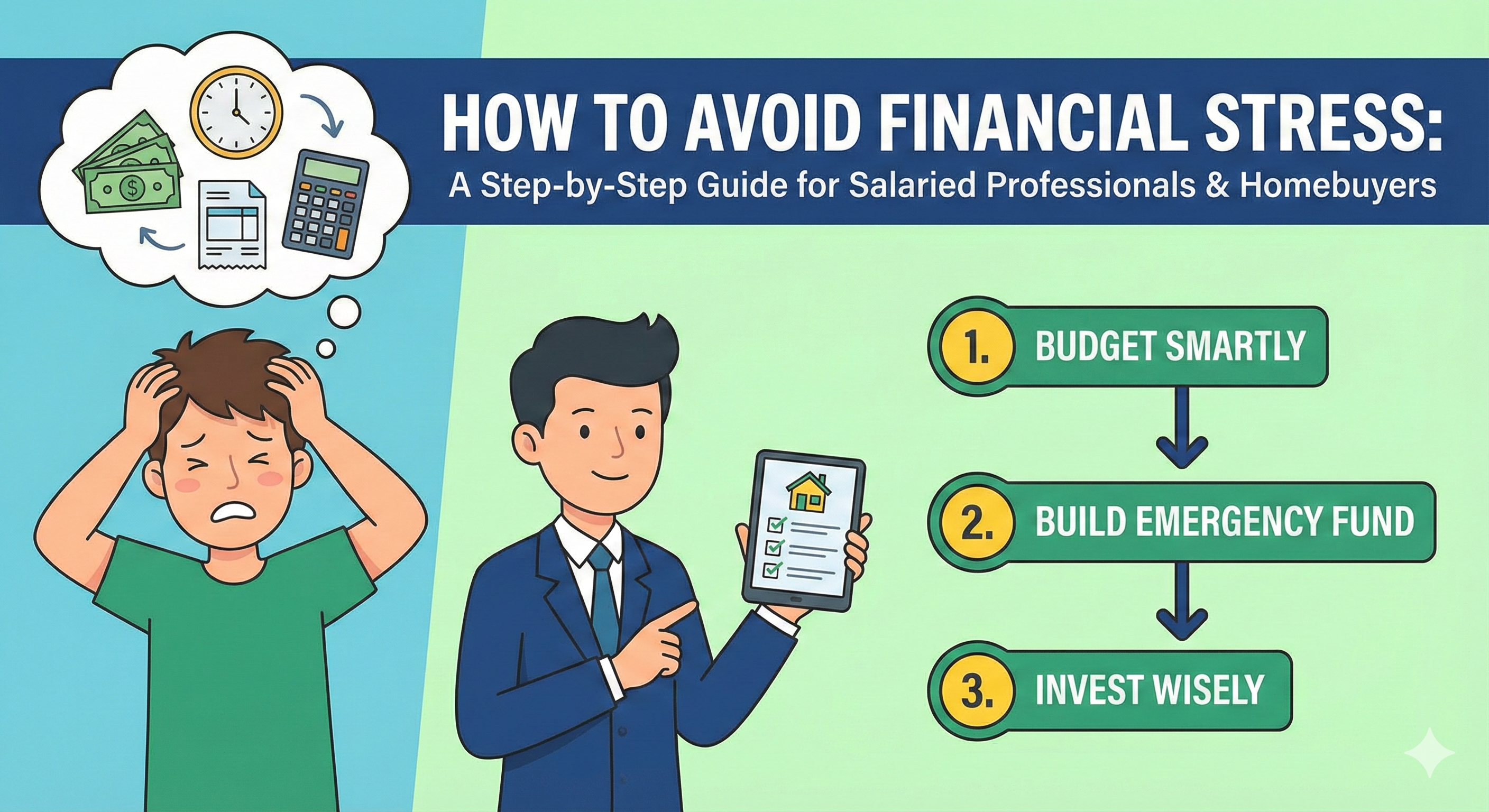
Introduction: The New Face of Financial Stress in India
There’s a strange paradox unfolding in India.
Our salaries are higher, our lifestyles are better, and yet… our financial stress is rising faster than our incomes.
Almost every week, someone walks into my financial planning practice looking calm from the outside—but battling silent financial anxiety within. Mid-career professionals, ambitious young couples, first-time homebuyers, people earning ₹25 lakh a year and even those earning ₹3 crore a year—the common thread is stress.
It’s not because they don’t earn enough.
It’s because they don’t plan enough.
Over the last 3 decades as a financial professional guiding thousands of individuals and families, I’ve noticed one clear pattern:
Most people wait too long before acknowledging they’re slipping into financial trouble.
This article is my attempt to give you a deeply practical, experience-based guide on how to detect, prevent, and eliminate financial stress—especially if you’re a salaried professional or someone planning to take (or currently paying) a home loan.
SECTION 1: The Invisible Stress You’re Probably Ignoring
Let me start with a story.
A few months ago, a couple from Bengaluru—both working in the IT sector—came to me after facing a sudden crisis. Their combined take-home salary was nearly ₹2.5 lakh per month. Respectable, stable, and comfortable. They booked a 2BHK flat worth ₹1.05 crore and started paying EMIs of ₹78,000 per month.
According to them, everything was “manageable”.
But when one of them faced an unexpected job loss during a restructuring, the entire structure collapsed.
Savings stopped.
Credit card debt started.
The emergency fund disappeared in three months.
Stress entered the marriage.
And soon, the home loan EMI looked like a mountain.
This wasn’t because they lacked intelligence or discipline.
It happened because they missed early warning signs.
That’s where our journey begins.
SECTION 2: Early Warning Signs Your EMIs Are Becoming Dangerous
Financial stress rarely arrives with a warning bell.
It is usually silent… subtle… creeping.
Based on real cases I’ve handled, here are the most common early warning signs:
1. Minimum credit card payments become a habit
You swipe freely, but at the end of the month, you only pay the “minimum amount due” because you want to preserve cashflow.
This is the first and most dangerous red flag.
Because paying the minimum means you’ve already lost control of your monthly budget.
2. Emergency fund withdrawals become more frequent
Most families withdraw from savings “just this one time.”
Then it becomes twice.
Then three times.
And suddenly the emergency fund shrinks—and EMI remains.
This is the second red flag.
3. SIPs get paused or stopped
When SIPs stop, it’s not a lack of money.
It’s an imbalance between earnings and obligations.
This leads to two things:
• EMI continues
• Wealth-building stops
A dangerous combination.
4. BNPL loans and short-term borrowings quietly increase
Buy Now Pay Later schemes are the new enemy of financial discipline.
They feel harmless but they silently create debt fragmentation.
You’re not in trouble because you took one BNPL loan.
You’re in trouble because you didn’t need to.
5. Your financial anxiety rises
This is a psychological sign.
You think about money before sleeping.
You worry about job security more than usual.
You avoid looking at your bank balance.
You get irritated when your spouse or children talk about expenses.
This internal uneasiness is the clearest sign that something is not right.
6. EMI-to-Income ratio silently goes beyond 35%
Ideally, EMIs should stay around 25–30% of your take-home salary.
But lifestyle inflation pushes many families up to 40–50%—without them realising.
Once your EMI crosses 35%, your savings rate declines, and that’s when stress begins.
7. Income becomes irregular, but EMI remains fixed
This is especially true for:
• startup employees
• freelancers
• project-based roles
• sales professionals
• bonus-dependent jobs
In personal finance, your EMI must match your worst month’s income, not your best month’s income.
Yet, people plan with the opposite mindset.
SECTION 3: Can You Really Afford a Home Loan? Here’s the Truth.
Let’s address the biggest elephant in the room.
Most Indians do not “plan” a home loan—they “assume” they can afford one.
Banks approve loans quickly.
Parents encourage buying early.
Friends pressure you because “everyone is buying.”
Relatives ask, “Ghar kab le rahe ho?”
Social media convinces you that renting is a waste of money.
And suddenly, you sign up for a 20-year EMI without fully understanding what it means.
So how do you actually assess affordability?
Here’s my 7-step Home Loan Readiness Framework I use for my clients:
Step 1: EMI must be 25–30% of take-home salary
This is non-negotiable.
If your EMI is ₹40,000 and your combined net household income is ₹1.2 lakh, it’s manageable.
But if EMI is 45–50%, your risk of EMI stress is extremely high.
Step 2: Your savings rate after EMI must be above 20%
If your EMI forces you to cut down SIPs…
If retirement contributions stop…
If you can’t save at least 20%…
You’re not buying a home.
You’re buying long-term anxiety.
Step 3: You must have a 9–12 month emergency fund
Especially post-COVID, this is essential.
For homebuyers, I insist they maintain:
• 6 months of household expenses
• • 3–6 months of EMIs
Without this, one job loss can collapse the entire household.
Step 4: You must evaluate your job stability
Ask yourself:
• Is my industry stable?
• Is my company profitable?
• Can my role be automated or outsourced?
• Is my income predictable?
Your EMI is fixed.
Your salary is not.
So plan your EMI based on the lower number.
Step 5: Check EMI-to-rent ratio
If your EMI is 3x your rent for a similar house, you must pause and rethink.
For example:
Rent = ₹25,000
EMI = ₹75,000
This is a major red flag.
Step 6: Do not mix emotional pressure with financial decisions
Many young professionals buy homes because:
• parents insist
• friends bought houses
• relatives create pressure
• they consider renting “wasteful”
In reality, renting is not a waste.
Renting is a cost of flexibility.
Step 7: Think long-term, not impulsively
If you don’t plan to live in a city for at least 7–10 years, buying a house is usually a bad idea.
A home is not a travel bag—you can’t shift it with a job.
SECTION 4: Budgeting — The First Line of Defense Against Stress
Most people think budgeting means:
“No fun, no eating out, no lifestyle.”
Not true.
Budgeting is simply awareness.
It is knowing where your money flows—and ensuring it flows in the right direction.
Here’s the budgeting formula I ask every professional to use:
The 50-30-20 Modified Rule (Taresh Version)
50% — Needs
30% — Wealth Building (SIPs, investments)
20% — Lifestyle & joy
Why 30% for wealth creation?
Because your future will not protect itself.
This structure ensures that even with rising EMIs, your investments stay on track.
SECTION 5: Emergency Fund — Your Financial Airbag
I say this repeatedly in my workshops:
“Your real safety net is not your job. It’s your emergency fund.”
During COVID layoffs, I saw two types of families:
1. Families with emergency funds — calm, collected, confident
2. Families without emergency funds — panic, high-interest loans, emotional breakdowns
Your expenses don’t stop when your job stops.
Electricity bill remains.
School fees remain.
Groceries remain.
EMI definitely remains.
An emergency fund protects your dignity and your dreams.
Target:
• Salaried professionals → 6 months expenses
• Dual income families → 9 months
• Homebuyers → 9–12 months
• Irregular earners → 12–18 months
SECTION 6: Are Young Indians Over-Leveraging Themselves? Absolutely.
The cultural pressure of home ownership in India is intense.
For many Indians:
• A house = stability
• A house = pride
• A house = adulthood
• A house = “settled life”
This pressure leads to poor financial decisions.
Here’s what I see every day:
• Young couples taking oversized loans
• Savings dropping to 5–10%
• SIPs being paused
• Retirement planning ignored
• Parents’ retirement money used as backup
• Financial stress causing relationship issues
My advice is simple:
Buy a house when you are ready. Not when society thinks you should be ready.
SECTION 7: Renting vs Buying — The Real Truth
Let’s finally settle this debate.
Renting isn’t wasting money.
Badly planned buying is.
When Renting is Smarter:
• You may relocate in 2–5 years
• EMI-to-rent ratio is too high
• You don’t have an emergency fund
• Job or income is unstable
• You’re prioritising lifestyle goals
• You want better cashflow flexibility
When Buying Makes Sense:
• Stable dual income
• Strong emergency fund
• You will stay in the same city long term
• EMI ≤ 30% of take-home salary
• Investments continue without interruption
There is no universal right answer.
There is only the financially correct answer for your situation.
SECTION 8: My 10-Step Action Plan to Avoid Financial Stress
If you want to eliminate financial stress, follow this step-by-step guide:
1. Calculate your EMI-to-income ratio
Target: 25–30%
2. Check your savings rate
Minimum: 20–25%
3. Track your credit card patterns
Rising balance = red flag
4. Build an emergency fund
6–12 months minimum
5. Reduce discretionary lifestyle expenses by 10–15%
Not permanently—just until stability returns
6. Avoid unnecessary EMIs
Phones, furniture, appliances—pay in cash wherever possible.
7. Create a monthly budget and review weekly
Use one sheet, one rule: Income – Savings = Expenses.
8. Revisit your home loan decision
Don’t be afraid to delay buying if the numbers don’t add up.
9. Prioritise health insurance and term insurance
Because one medical emergency can destroy years of savings.
10. Start SIPs—even small ones
₹500 today is better than ₹0 tomorrow.
SECTION 9: Final Thoughts — A House Should Give You Stability, Not Suffocation
I often tell my clients this one truth:
“Your home should bring you peace, not pressure.”
The whole purpose of financial planning is not to restrict you—but to protect you.
Protect your dreams.
Protect your lifestyle.
Protect your dignity.
Financial stress doesn’t come from EMIs.
It comes from taking EMIs without a plan.
Plan first.
Buy later.
That is the real path to financial wellness.
Want to Learn My Full Framework Step-by-Step?
Here are two powerful, all-ready tools written exactly in my Richness Academy format:
1️⃣ Home Loan Readiness Checklist (printable & session-ready)
2️⃣ Rent vs Buy Calculator (logic + formulas + questions to ask + decision tree)
These are written in a way that you can directly use.
✅ 1. HOME LOAN READINESS CHECKLIST
(A practical, 10-minute self-assessment for Indian professionals & couples)
SECTION A — Income Stability (Score: 0–10)
Tick all that apply:
1. □ My job/role is stable for the next 2–3 years
2. □ My industry is not going through layoffs or restructuring
3. □ My spouse/partner also has a stable income
4. □ My income does not depend heavily on bonuses/incentives
5. □ I have at least one alternate income (side income, rent, dividends)
Score 0–2 = High Risk
Score 3–4 = Medium
Score 5 = Strong Stability
SECTION B — EMI Affordability (Score: 0–10)
1. □ EMI is NOT more than 25–30% of our combined take-home salary
2. □ After EMI, we still save 20–25% every month
3. □ We are NOT depending on future salary hikes to afford EMI
4. □ We can handle a 10–15% EMI shock if interest rates rise
5. □ We are not taking a loan tenure beyond 20 years
Score 0–2 = EMI Too High
Score 3–4 = Adjust before buying
Score 5 = Balanced & Safe
SECTION C — Emergency Fund & Liquidity (Score: 0–10)
1. □ We have 6–9 months of expenses saved
2. □ We have additional 3–6 months of EMIs saved
3. □ We have a separate medical emergency kitty
4. □ Our investments are not locked in ELSS/FDs for down payment
5. □ We have not touched PF/parents’ retirement funds for down payment
Score 0–2 = Not Ready
Score 3–4 = Weak Buffer
Score 5 = Ready for Home Loan
SECTION D — Down Payment Readiness (Score: 0–10)
1. □ Our down payment is at least 20–25%
2. □ We have budgeted 8–10% extra for stamp duty, GST, registration
3. □ We have avoided “zero down payment” schemes
4. □ Our down payment is NOT from personal loans/credit cards
5. □ Down payment will NOT wipe out our emergency savings
Score 0–2 = Risky
Score 3–4 = Manageable
Score 5 = Healthy Readiness
SECTION E — Life Plan & City Stability (Score: 0–10)
1. □ We plan to live in this city for at least 7–10 years
2. □ Our career growth is in the same city/industry
3. □ No major relocation is expected in the next 3–5 years
4. □ Children’s future schooling is in this area (if applicable)
5. □ We are not buying solely due to family or societal pressure
Score 0–2 = Very Likely to Sell Early
Score 3–4 = Think Again
Score 5 = Long-Term Fit
TOTAL SCORE: /50
INTERPRETATION
• 41–50 → READY
You can safely explore your home purchase.
• 31–40 → NEARLY READY
Fix a few gaps (emergency fund, EMI ratio, down payment).
• 21–30 → NOT READY
Buying now may increase financial stress.
• Below 20 → HIGH RISK
Rent for now. Build safety nets before committing.
🔑 CFP® Taresh’s Thumb Rule
“If your home loan destroys your ability to invest, you are buying stress, not security.”
✅ 2. RENT vs BUY CALCULATOR (Indian Context)
A step-by-step tool + exact formulas you can use in sessions
STEP 1 — Calculate your EMI-to-Income Ratio
Formula:
EMI ÷ Monthly Take-Home Income × 100
Ideal: 25–30%
Risk Zone: 35%+
Danger Zone: 40%+
STEP 2 — Calculate Rent-to-EMI Ratio
Formula:
EMI ÷ Rent for Similar Property
If EMI is 3× the rent → Renting is smarter
Example:
Rent = ₹25,000
EMI = ₹75,000
Ratio = 3 → BUYING is NOT advisable
STEP 3 — Calculate Renting Advantage
Formula:
(EMI – Rent) × 12 × Years
This amount becomes investible.
Example:
Rent = ₹25,000
EMI = ₹75,000
Difference = ₹50,000/month
Yearly = ₹6,00,000
10 years = ₹60,00,000 investible capital
Investing this can outperform property appreciation in 80% cases.
STEP 4 — Calculate Property Appreciation Need
Formula:
To justify buying, property must appreciate at least 7–9% per year (real terms).
Most Indian metro suburbs are appreciating at 3–5%.
STEP 5 — Calculate Emergency Fund Requirement
(Homebuyers Only)
Monthly expenses × 6
+
Monthly EMI × 3–6
(Essential because stress hits the hardest when job loss + EMI overlap.)
STEP 6 — Maintenance & Holding Cost Formula
Annual Cost =
• Society maintenance
• Repairs
• Property tax
• Brokerage
• Insurance
• Opportunity cost (down payment interest loss)
Usually 1.5–2% of property value annually.
Renting avoids this cost completely.
STEP 7 — 10-Point Decision Tree
Answer YES / NO for each:
1. Do you have dual stable incomes?
2. Can you stay in the city for 7–10 years?
3. Do you have 9–12 months emergency fund?
4. Will EMI be ≤ 30% of income?
5. Will investments still continue?
6. Will EMI-to-rent ratio be < 2.2×?
7. Is the down payment > 20%?
8. Has the property location grown steadily for 10+ years?
9. Do you have zero short-term loans?
10. Are you buying for utility, not ego or pressure?
Score 8–10: BUYING makes sense
Score 5–7: RECHECK numbers
Score ≤4: RENTING is financially smarter
🔑 CFP® Taresh’s Rent vs Buy Rule
“Own when it strengthens your life plan. Rent when it strengthens your financial freedom.”
Then join me for my Financial Planning Masterclass (₹99):
👉 https://tinyurl.com/TB-TFPMC
Or read more at my blog:
👉 https://blog.tareshbhatia.com
Follow me on Instagram for daily insights:
👉 https://tinyurl.com/InstagTB
YouTube:
👉 https://tinyurl.com/SubscTB
Disclaimer: The views expressed are for educational purposes only and do not constitute financial, investment, tax, or legal advice. Please consult qualified professionals before making decisions. Mutual fund investments are subject to market risks.
👉 Full Disclaimer | Disclosures | Terms of Use
| 👉Join my FAN page at: | facebook.com/CFPTareshBhatia |
| 👉Follow on Facebook: | facebook.com/TareshBhatiaCFPro |
| 👉Follow me on Instagram: | instagram.com/tareshbhatiacfp |
| 👉Follow me on Threads: | threads.net/@tareshbhatiacfp |
| 👉Follow me on Twitter: | twitter.com/tareshbhatiacfp |
| 👉Follow me on LinkedIn: | linkedin.com/in/tareshbhatiacfp |
| 👉Visit Website: | tareshbhatia.com |
| 👉Read Blog: | blog.tareshbhatia.com |
| 👉Buy my Book: | pages.razorpay.com/BookTRP |
| 👉Join me on Telegram: | t.me/+v0ewUJQU0wowN2Jl |
| 👉YouTube Channel: | youtube.com/@Taresh-Bhatia |
| 👉Subscribe: | tinyurl.com/SubscTB |
| 👉Join my Academy: | therichnessacademy.com |
| 👉Complimentary Session-Limited Offer: | learn.therichnessacademy.com/web/checkout/686f9d1203ac6c6374689439 |
| 👉WhatsApp message directly: | wa.me/919810127906 |
| 👉Get Ebook: | tinyurl.com/TenEbook |
The author of this article, Taresh Bhatia, is a Certified Financial Planner® and advocate for female empowerment. For more information and personalized financial guidance, please contact taresh@tareshbhatia.com
He has authored an Amazon best seller-“The Richness Principles”. He is the Coach and founder of The Richness Academy, an online coaching courses forum. This article serves educational purposes only and does not constitute financial advice. Consultation with a qualified financial professional is recommended before making any investment decisions. An educational purpose article only and not any advice whatsoever.
©️2025: All Rights Reserved. Taresh Bhatia. Certified Financial Planner®
Subscribe Now for Upcoming Blogs!
[convertkit form=6555951]
📢 Join free live webinar —
Couple Finance Formula™ Register here