

1) Why you need a vision board or vision book
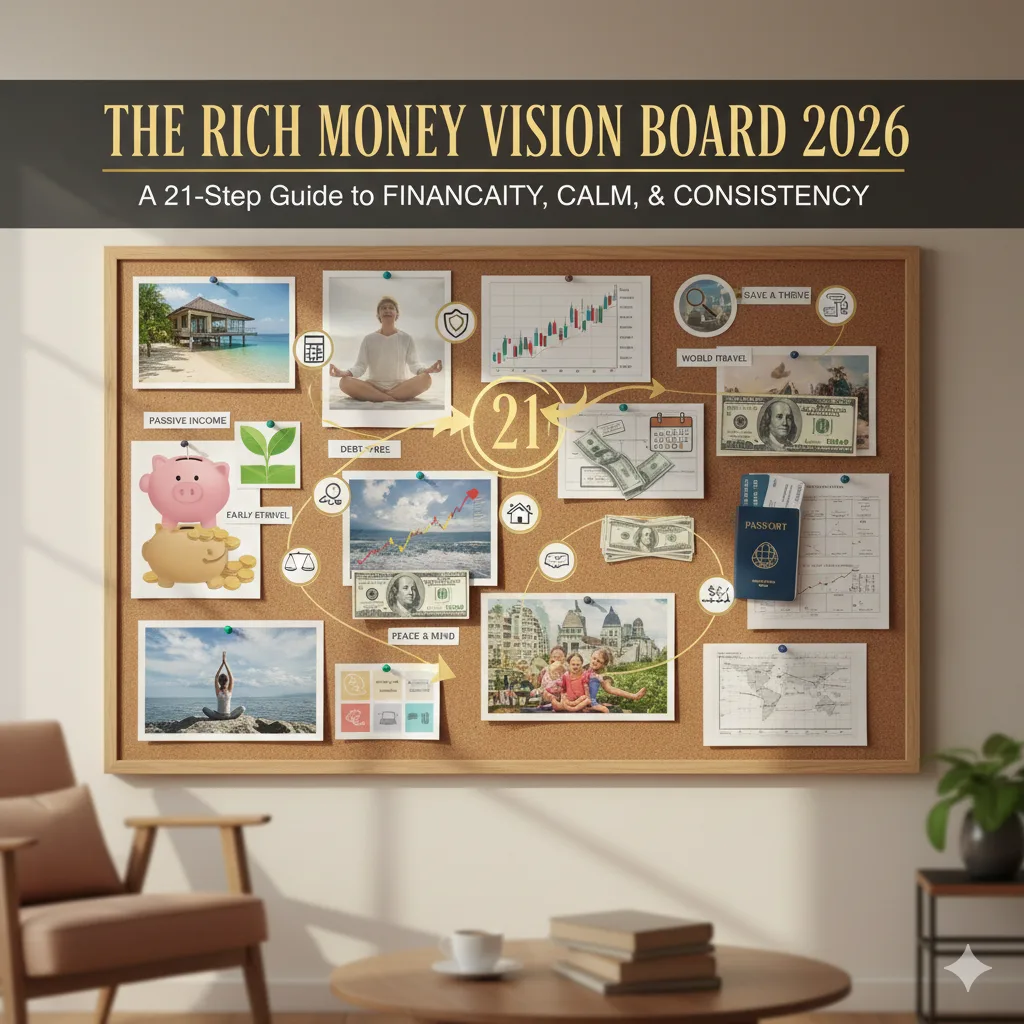
A Money Vision Board is not a poster. It is a process of becoming. The real question isn’t “What do I want?” but “Who am I becoming while creating what I want?” Because money outcomes are always a reflection of identity—how safe you feel with growth, responsibility, discipline, and receiving. Most people say they want a new financial reality, but their subconscious still runs the old safety program: scarcity, fear of loss, “I’m not ready,” “It won’t last,” “What if I fail?” A vision board works when it becomes a bridge between your desire and your nervous system. Your goal is to create indicators—images, words, symbols—that trigger emotions now, so your mind can rehearse the reality before it arrives. It’s emotional rehearsal. You’re training the brain to feel safe with the new you. I’ve seen high earners still feel poor because their inner identity hasn’t upgraded. And I’ve seen modest earners become stable because their identity became disciplined and calm. So in Step 1, decide what you want to create and experience, yes—but more importantly, decide what kind of person you need to be to hold it peacefully.
Exercise: Write: “In 2026, I am becoming the kind of person who feels ______ about money and behaves with ______ every day.”
2) Ask: what will this goal give me so that I feel…
This is the emotional engine. Money itself is neutral; what you want is the feeling: safety, freedom, pride, respect, calm, choice. When people set goals without identifying the feeling, they either lose motivation or keep moving the goalpost. If you don’t define the feeling, even success feels empty. I ask clients: “If you got this goal today, what would change in your body?” Because your body tells the truth—relaxation, relief, confidence, dignity. That feeling is your real destination. And when you connect to it daily, actions become natural. You stop forcing discipline; you start living from a deeper reason. This is also how you prevent financial decisions driven by ego. Many people chase goals to prove something—then the money comes with pressure, not peace. Step 2 helps you clean that.
Mini anecdote: One client wanted a big corpus number. When we asked “so that you feel…”, the answer was “I can finally breathe.” That changed the plan: we shifted focus to emergency fund, insurance, and cashflow—his breathing returned first, then wealth grew.
Exercise: Write 3 endings: “I want ____ so that I feel ____.” Choose the one that makes your chest feel lighter.
3) Means goal vs Ends goal (₹1 crore → ₹75,000/month freedom)
This is where clarity becomes surgical. A Means Goal is the measurable number (₹1 crore by Dec 2026). An Ends Goal is the lived outcome (₹75,000/month passive income, choice, calm). Most people chase means goals because they are clean numbers; but meaning lives in the ends goal. In your board, always keep both together so the subconscious understands the why. This prevents you from becoming a slave to a number. It also helps you make smarter strategies—because the means can change as long as the ends are achieved. The ends goal is what your life will look like: mornings without panic, decisions without guilt, a family that feels protected. When you place both goals on your vision board, you create an identity anchor: “I’m not chasing a crore; I’m creating freedom.”
Mini anecdote: I’ve seen people hit their target corpus and still feel anxious because the ends goal wasn’t defined. They had money, not meaning. When we defined the ends goal, suddenly investment choices became calmer and more aligned.
Exercise: Write one means goal and one ends goal. Then add: “This will allow me to experience ______ (daily life picture).”
4) 2026 short-term (80%) and 2035 long-term (20%)
Your original thinking here is wise: don’t overload 2026 with distant fantasies. Keep 2026 practical and execution-heavy, and keep 2035 as the long arc. When people put only long-term goals, they feel overwhelmed. When they put only short-term goals, they feel directionless. The 80/20 split creates both momentum and meaning. For 2026, focus on habits, systems, and cashflow clarity. For 2035, focus on wealth identity: “I am a long-term investor, a calm decision-maker, someone who plans.” This split also protects you from market noise. When the market distracts you, the long arc reminds you to stay steady.
Mini anecdote: I’ve watched professionals burn out by setting too many 10-year goals in January. By March, nothing moves. But when we put 2026 into 10–12 practical targets and kept 2035 as 2–3 anchor visions, the year became productive without anxiety.
Exercise: Write 8 short-term goals for 2026 and 2 long-term visions for 2035. Underline the 2 that feel most emotionally important.
5) Use AI tools with your photo + images (money flowing, passive income streams)
AI is not the magic. AI is a tool to create visual specificity. The subconscious loves specificity. When you use an AI tool with your photo and your desired reality—multiple passive income streams, calm home, organised desk, family travel—you are building an emotional storyboard for your mind. But do it with dignity. Avoid visuals that feel fake or excessive; your nervous system should accept the image as “possible.” I recommend prompts that highlight stability: “calm, structured, disciplined, secure.” The objective is not luxury; it is normalisation. Also, use AI to create category images: wealth, health, relationships, spirituality, mindset. Because money alone doesn’t make you whole.
Mini anecdote: A client used a flashy supercar collage. It increased pressure. When we redesigned visuals around calm routines—morning walk, debt-free statement, investment dashboard—the anxiety reduced and execution improved.
Exercise: Create 3 visuals: (1) calm wealth identity, (2) disciplined daily routine, (3) family safety. Pick the one that makes you feel most grounded, not most excited.
6) Get it printed large as a poster
Scale matters. A small picture inside a phone album does not train identity. A large poster signals importance. It becomes a “mirror” you see daily. Your eyes land on it, your mind rehearses it. This repetition creates familiarity. Print quality matters too—because your brain responds to what feels premium and intentional. A cheap print subconsciously tells you “this isn’t serious.” Place the poster where your morning begins or where your work happens. Not hidden. Not occasional. Daily.
Where: bedside wall, study corner, wardrobe door, or behind your desk monitor.
Mini anecdote: I’ve seen people keep goals in Notes app for years. Nothing changes. The moment a physical board is placed where they see it daily, consistency starts—not because the board is magic, but because attention becomes structured.
Exercise: Decide the “first look location” and the “last look location.” First in the morning, last at night. That is how you bookend identity.
7) Sit and connect with the larger you: is it possible? is this your future?
This is the honesty step. Sit with the image and notice your internal reaction. Excitement is good, but resistance is more valuable. Resistance shows belief gaps. If you feel “this can’t happen,” don’t force positivity. Ask: “Which part feels unsafe?” Often it’s not the goal; it’s the responsibility that comes with it. Your future self is bigger—not louder, not arrogant—just steadier. Your job is to connect with that steadiness.
Mini anecdote: One business owner wanted passive income but felt guilty receiving without working. The board surfaced that guilt. Once addressed, he could actually build systems.
Exercise: Look at your board for 5 minutes in silence. Write: (1) “This feels possible because…” (2) “This feels difficult because…” (3) “The first bridge step I can take is…”
8) Make the new reality clear in words: affirmations
Images create emotional triggers. Words create identity commands. Your affirmations are “words of power” because they tell the subconscious: “This is who I am now.” But affirmations must be grounded. They should feel like the next believable step, not an unrealistic jump. The best affirmations include behaviour + emotion: “I act with discipline and feel calm.” Add clarity words like: consistent, structured, intentional, protected. Use your own voice.
Mini anecdote: When I ask clients to write affirmations, they copy internet lines. Those don’t work. The affirmations that work are personal: “I no longer delay my financial decisions. I do the right thing on salary day.”
Exercise: Write 7 affirmations starting with “I am…” and include one action verb each: “I save… I invest… I review… I protect… I learn…”
9) Put words + images into categories (health, wealth, relationships, etc.)
A mature money vision board is life-complete. Divide your board or vision book into sections: wealth, health, relationships, business, spirituality, mindset, career, experiences, contribution. This stops you from becoming financially rich but personally drained. Also, it prevents you from using money as compensation for other emptiness. Each category should have 1–3 visuals and 2–3 words. Keep it clean.
Where: on chart paper (vision board) or multi-page (vision book).
Mini anecdote: People who focus only on wealth often experience burnout. When health and peace are included visually, their money decisions become calmer and more sustainable.
Exercise: Create 8 categories. Under each, write 2 words of power and 1 “daily identity behaviour.” Example: Health → “energy, discipline” → “I walk daily.”
10) Make a 10–12 goal list (burning desires) as one-liners
These one-liners become your “north stars.” They should be emotionally true and personally meaningful. Not a long wish list. Pick 10–12 that matter most. Your examples are perfect: income identity, passive income, fitness without medicines, joyful work, financial independence. These should go on the last page of your vision book and also on a separate sheet. The key is: make them readable in 60 seconds. Because you will read them daily.
Mini anecdote: I’ve seen people write 40 goals. That creates overwhelm. The best transformations come from fewer goals repeated deeply.
Exercise: Write 12 goals in one sitting. Then circle the 3 that make you feel emotional. Those are your real burning desires.
11) Write goals as if they have happened (present tense)
Present tense is subconscious language. “I will” keeps it in the future. “I am” brings it into identity. But do it with grounded confidence, not fantasy. “I am consistent with my SIPs and I feel calm.” “I earn ₹X consistently and my systems run smoothly.” The present tense helps you behave as that person today.
Mini anecdote: The biggest change I see in clients is when they stop saying “I will start” and start saying “I am the kind of person who…” That shift creates action without force.
Exercise: Rewrite your 12 goals in present tense. Then add one line below each: “This is true because I do ____ daily/weekly.”
12) Keep the board/book beside you; read every morning
This is exposure therapy for the subconscious. You’re training familiarity. The board must be visible and accessible. Not stored away. Every morning, read the affirmations and the 10–12 goals. Don’t rush. This is not a checklist; it’s identity anchoring.
Where: beside bed, desk, prayer space, or wherever your day begins.
Mini anecdote: People tell me “I don’t have time.” But they scroll 15 minutes. This is a better 10 minutes. It sets the emotional direction of your day.
Exercise: Commit to a 21-day streak. Put a small tick mark daily. Don’t break the chain.
13) First 10 minutes: silence, feel emotions, “Today I am…”
This is your most powerful step. Read the board, then sit in silence and feel as if it’s already true. Ask: “How do I feel?” Relief? Pride? Calm? Freedom? Let your body experience it. This emotional rehearsal reduces internal resistance. It makes your mind safe with the new reality.
Mini anecdote: Many people can visualise, but they can’t feel. Feeling is what rewires. When they finally feel calmness, their decisions become calm too.
Exercise: Choose one goal. Spend 2 minutes feeling it fully. Then write one line: “Today I am ______.”
14) Daily practice creates “abundance normalisation”
Abundance normalisation means the unfamiliar becomes familiar. That’s crucial. Because many people self-sabotage when money grows: they overspend, panic invest, stop tracking, or feel guilty. Normalisation makes growth feel safe. You stop reacting. You start managing.
Mini anecdote: A client increased income but felt anxious, so he increased lifestyle spending to “feel normal.” Normalisation would have allowed him to hold growth calmly and invest.
Exercise: Write: “It is safe for me to grow.” Repeat daily for 21 days. Notice how your decisions change.
15) This takes time; removes urgency; builds adaptability
This is mature thinking. You are not trying to force results. You are building a new baseline. When urgency reduces, better choices appear. Urgency creates mistakes. Adaptability creates consistency. This process trains patience. It tells your body: “We are not in danger.”
Mini anecdote: People who chase quick wins often create quick losses. People who build calm systems create long wealth.
Exercise: Identify one urgent behaviour (panic checking markets, impulsive buys). Replace with one calm ritual (weekly review, monthly SIP day).
16) Take necessary actions: behave as the New You 2026
Vision without action is entertainment. Action without vision becomes burnout. Your board should lead to daily aligned behaviour. Ask: “What would my 2026 self do today?” Then do one small step: track spending, review SIPs, learn, organise documents, reduce one expense. Consistency is the true hack.
Exercise: Write 5 “New You” behaviours. Pick 1 daily and 1 weekly.
17) Progress is internal too; awareness creates new patterns; don’t give up
This is key. External results take time. Internal changes show earlier: better self-control, less fear, more clarity. Celebrate that. It means rewiring is happening. Most people quit because they only measure external results. But wealth is first built internally.
Exercise: Every week write 3 internal wins: “I didn’t panic… I stayed consistent… I reviewed calmly…”
18) Stay true to the New 2026 happening now in consciousness
This step is loyalty. Old identity will pull you back under stress. The new you must be practised daily. Don’t wait for perfect conditions. Stay true when it’s boring, when it’s slow, when nobody is clapping. That’s where transformation locks.
Exercise: Write a “tough day script” you will read: “Even today, I stay calm and do one right action.”
19) Understand your new patterns (deep observation)
Now you become a student of your own mind. You observe triggers: stress → spending, fear → avoidance, excitement → risk-taking. Patterns are not personality; they are learnt responses. Naming them creates control. You stop saying “I’m bad with money” and start saying “This is my fear pattern activating.” That shift is power.
Exercise: Track for 7 days: trigger → behaviour → emotion. Write one new response you want to install.
20) Let courage come from these new progress steps
Courage is not a mood. Courage is a byproduct of action. Each small aligned step teaches the nervous system: “I can handle this.” You don’t need grand gestures—just consistent brave micro-choices: continue SIPs, say no to unnecessary spending, review calmly, ask for help, learn the basics. That is courage.
Exercise: Choose one uncomfortable financial action this week and do it gently.
21) Believe, have faith, and make progress every day in 2026
Belief gives direction. Faith gives patience. Progress gives proof. This final step is not motivational—it’s foundational. Some days you won’t see results. That’s okay. Your job is to stay loyal to the process. Daily progress can be tiny: one right decision, one avoided impulse, one review, one learning step. Over 365 days, that becomes identity. And identity becomes wealth.
Exercise: Every night write one line: “Today I stayed loyal to my 2026 self by ______.”
Disclaimer: The views expressed are for educational purposes only and do not constitute financial, investment, tax, or legal advice. Please consult qualified professionals before making decisions. Mutual fund investments are subject to market risks.
👉 Full Disclaimer | Disclosures | Terms of Use
| 👉Join my FAN page at: | facebook.com/CFPTareshBhatia |
| 👉Follow on Facebook: | facebook.com/TareshBhatiaCFPro |
| 👉Follow me on Instagram: | instagram.com/tareshbhatiacfp |
| 👉Follow me on Threads: | threads.net/@tareshbhatiacfp |
| 👉Follow me on Twitter: | twitter.com/tareshbhatiacfp |
| 👉Follow me on LinkedIn: | linkedin.com/in/tareshbhatiacfp |
| 👉Visit Website: | tareshbhatia.com |
| 👉Read Blog: | blog.tareshbhatia.com |
| 👉Buy my Book: | pages.razorpay.com/BookTRP |
| 👉Join me on Telegram: | t.me/+v0ewUJQU0wowN2Jl |
| 👉YouTube Channel: | youtube.com/@Taresh-Bhatia |
| 👉Subscribe: | tinyurl.com/SubscTB |
| 👉Join my Academy: | therichnessacademy.com |
| 👉Complimentary Session-Limited Offer: | learn.therichnessacademy.com/web/checkout/686f9d1203ac6c6374689439 |
| 👉WhatsApp message directly: | wa.me/919810127906 |
| 👉Get Ebook: | tinyurl.com/TenEbook |
The author of this article, Taresh Bhatia, is a Certified Financial Planner® and advocate for female empowerment. For more information and personalized financial guidance, please contact taresh@tareshbhatia.com
He has authored an Amazon best seller-“The Richness Principles”. He is the Coach and founder of The Richness Academy, an online coaching courses forum. This article serves educational purposes only and does not constitute financial advice. Consultation with a qualified financial professional is recommended before making any investment decisions. An educational purpose article only and not any advice whatsoever.
©️2025: All Rights Reserved. Taresh Bhatia. Certified Financial Planner®
Subscribe Now for Upcoming Blogs!
[convertkit form=6555951]
📢 Join free live webinar —
Couple Finance Formula™ Register here