

Prologue: The Question That Changes You Forever
Every once in a while, as a CFP, I hear a question that doesn’t leave my mind for days.
Not because it is complicated.
Not because it requires spreadsheets or formulas.
But because it comes from a place so deep… that you feel the weight of someone’s entire life resting on it.
A few months ago, a parent asked me something that froze me mid-sentence:
“Taresh… after I am gone, who will take care of my child?”
Not the finances.
Not the investments.
Not the paperwork.
The child.
A 21-year-old autistic son who cannot manage money on his own.
A gentle, bright boy who sees the world differently.
A child whose entire life—every rupee, every therapy session, every medicine refill, every hospital visit—depends on his parents’ health and ability to function.
And that simple, fragile, heart-breaking question opened up an entire world that many Indian families rarely talk about:
How do you financially secure a lifetime of care for a special-needs dependent… after you are no longer around?
This is the story of one such family.
But truly—it is the story of thousands of families across India.
1. The Meeting That Set the Tone
His name (changed for privacy) was Suresh Kumar, a 57-year-old entrepreneur from Delhi.
A man who had seen success.
A man who had built wealth.
A man who could make decisions.
But that day, I saw before me a worried father.
He did not come to talk about returns.
Or tax optimisation.
Or SIPs.
Or mutual funds.
He came with a single, burning, urgent concern:
“How do I secure my autistic son’s future for the next 50 years… even if I am not here tomorrow?”
His wife sat beside him—calm, composed, but her eyes told a different story.
Fear.
Responsibility.
Loneliness.
Questions that she had never said aloud.
They had no extended support structure.
No siblings to fall back on.
No cousins living nearby.
Ageing parents.
A nuclear family.
This is the reality of millions of Indian urban families today.
And yet—no one discusses it at the dinner table.
2. The Unspoken Truth About Special-Needs Financial Planning
When parents are alive and healthy, the world feels manageable.
But life does not come with guarantees.
And as financial planners, our job is not only to calculate returns—it is to calculate risks that cannot be taken.
For most families, “risk” means:
✔ market volatility
✔ inflation
✔ taxation
✔ interest rate cycles
But for families with differently-abled dependents, risk has a whole new meaning:
👉 What if the caregiver falls sick?
👉 What if one parent dies?
👉 What if both pass away?
👉 What if the dependent cannot express their needs?
👉 What if someone mishandles the money?
This is not about preserving wealth.
It is about preserving care.
And the best instrument to do that in India—one that is powerful, flexible and legally strong—is:
A Revocable Special Needs Trust.
3. Why a Trust and Not Just a Will?
Many parents believe a simple will is enough.
Let me say this clearly:
👉 A will only transfers assets.
👉 It does NOT manage them.
👉 It does NOT protect them.
👉 It does NOT ensure lifetime care.
A trust does what a will can never do:
✔ It holds the money.
✔ It manages the money.
✔ It protects the money.
✔ And it spends the money ONLY for the child’s care.
That is the beauty of a trust.
It becomes a living system that continues even when the parents are no longer there.
4. How We Designed the Special Needs Trust for This Family
Let me walk you through exactly how we structured it.
A. The Trust Was Set Up in the Mother’s Name
This was a conscious decision.
The father had a high taxable income from business.
Creating the trust in his name would have caused clubbed taxation—meaning trust income would be taxed at his slab rate.
So we set it up in the mother’s name.
Cleaner.
More efficient.
Tax-friendly.
B. Both Parents Were Trustees + Primary Beneficiaries
This ensured two things:
1. They could use trust money for their own medical or living expenses as they aged.
2. They retained full control during their lifetime.
The son—Adinath (name changed)—would become the sole beneficiary after their passing.
C. An External Trustee Was Appointed
This is crucial in special-needs situations.
Parents age.
Parents fall sick.
Parents cannot always manage paperwork.
So we added:
🔹 a trusted family friend as co-trustee,
🔹 who would directly handle payments to hospitals, therapists, special schools, and assisted-living centres.
In many cases, families also appoint:
✔ a corporate trustee
✔ a professional fiduciary
✔ a legal guardian under the RPWD Act
Each situation is unique—but an external trustee is non-negotiable.
D. A “Protector” Was Added
This is a concept most Indian families are unaware of.
A Protector is someone who oversees the trustee—
like a watchdog.
A family representative who ensures:
✔ there is no misuse
✔ withdrawals follow rules
✔ investments follow the IPS
✔ the dependent’s dignity is protected
It is an added layer of emotional and financial security.
5. The Asset Transfer Strategy: What Goes into the Trust?
This step must be planned with precision.
Existing Properties
Instead of transferring them into the trust (which would trigger stamp duty), we recommended:
👉 Transfer through a will.
Zero stamp duty.
Zero immediate cost.
Full clarity.
Future Properties
Any future real estate should be bought directly in the trust’s name.
This avoids future legal transfers and potential disputes.
Financial Assets
These would slowly be moved into the trust:
✔ MFs
✔ FDs
✔ Bonds
✔ Insurance maturity amounts
✔ Pension payouts
✔ Rental income
Over time, every rupee sits under one structure.
This is how you ensure that nobody can mismanage it, misuse it, or access it without rules.
6. The Most Important Document: Investment Policy Statement (IPS)
A trust is a structure.
But the IPS is the engine that runs it.
Let me explain this with an anecdote.
Anecdote: The Cousin Who “Invested” the Trust Money
A family I once worked with had appointed a cousin as a trustee.
Good man.
Well-intentioned.
But financially… inexperienced.
He wanted to “help the trust grow faster”.
So he shifted a major portion into small-cap stocks because his friend recommended them.
Within two years, the trust corpus was down 38%.
There was:
✘ no IPS
✘ no rules
✘ no monitoring
✘ no restrictions
This is why an IPS is critical.
What Is an IPS?
An IPS (Investment Policy Statement) is a formal document dictating:
✔ How the trust money must be invested
✔ What risks cannot be taken
✔ What limits must be followed
✔ How much can be withdrawn each year
It removes human emotion from money management.
Typical IPS Rules for Special Needs Trusts
A well-written IPS includes:
A. Minimum Bond Ratings
No debt instrument below AA–.
B. Liquidity Requirements
At least 20–30% always in liquid or short-duration instruments.
C. Equity Caps
Limit mid- and small-cap exposure (often below 15–20%).
D. Withdrawal Ceiling
Maximum annual withdrawal = 3% inflation-adjusted.
E. Risk-Managed Asset Allocation
Designed to protect lifetime care, not chase returns.
7. The Withdrawal Strategy: The Heart of Lifetime Care
This is where most families make mistakes.
Parents assume the trust needs:
✔ high returns
✔ growth orientation
✔ aggressive funds
But the truth is:
Special-needs planning is not about high returns — it is about zero failure.
The child may live 50–60 more years.
The corpus must last longer than the child’s lifetime.
There are two withdrawal strategies:
A. Static Withdrawal (For Large Corpus Families)
If the family has a strong corpus, we use:
👉 fixed withdrawal
👉 inflation-adjusted
👉 stable
👉 predictable
Expenses remain constant every year.
B. Dynamic Withdrawal (When Corpus Is Limited)
A brilliant, underused strategy in India.
The rule is simple:
👉 In good market years → withdraw slightly more
👉 In bad years → withdraw less
This ensures:
✔ the corpus survives
✔ discretionary expenses reduce when needed
✔ no risky investments are taken
✔ lifestyle remains stable
Families often find peace with this approach, because it removes the pressure of “growing” the corpus aggressively.
8. The Mathematics Behind Special-Needs Planning
Many parents avoid numbers.
But numbers give clarity.
When estimating a lifetime care requirement, planners consider:
✔ city of residence
✔ type of disability
✔ therapies
✔ assisted-living costs
✔ specialised medical care
✔ inflation
✔ years of dependency
✔ emergencies
Only then do we back-calculate:
👉 required trust corpus
👉 required investment return
👉 withdrawal rate
👉 asset allocation
The maths is the same for all individuals—
but the parameters change completely for special-needs dependents.
9. A Story From My Practice: The Mother Who Planned Early
Let me share another story.
A young mother from Gurugram once came to me with her 6-year-old daughter diagnosed with Down Syndrome.
She said:
“Taresh, I want to start now. I don’t want to wait.
I don’t want my other child to feel burdened.
I want both my children to live with dignity.”
She started a small SIP.
Then increased it each year.
Then got her husband involved.
Then created a trust by the time she turned 40.
Today the corpus is strong, protected and designed to outlive both parents.
Early planning changes everything.
10. Estate Planning: The Missing Piece
Many Indian parents believe buying a house and keeping some FDs is enough.
But estate planning for special-needs individuals must include:
✔ A Will
✔ A Trust
✔ A Guardian Appointment under RPWD Act
✔ Documented care instructions
✔ Emergency contact structure
✔ IPS
✔ Medical directives
You are not planning assets.
You are planning a lifetime of dignity.
11. The Emotional Journey of Parents
Over the years, I have witnessed every emotion in these conversations:
✔ fear
✔ guilt
✔ love
✔ stress
✔ resilience
✔ hope
Parents worry:
👉 Who will understand my child?
👉 Who will protect them?
👉 Will someone mistreat them?
👉 Will they run out of money?
👉 How will they communicate needs?
This is why special-needs financial planning is not a “service”.
It is a lifeline.
A trust brings structure.
An IPS brings discipline.
A withdrawal plan brings stability.
A protector brings oversight.
A guardian brings long-term care.
And together — they create peace
12. What Every Parent of a Special-Needs Child Must Do Today
Here is the exact checklist I give my clients:
1. Create a Special Needs Trust (revocable or irrevocable)
2. Write a detailed will
3. Appoint trustees + protector + guardian
4. Prepare an IPS with clear investment rules
5. Document monthly and annual expenses
6. Estimate lifetime care with inflation
7. Move financial assets slowly into the trust
8. Buy future property directly in trust name
9. Avoid risky investments
10. Document medical care instructions
11. Communicate the plan to extended family
12. Review annually
Planning once is not enough.
Planning must evolve.
13. The Final Outcome for This Family
Coming back to the case of Mr. Das…
After three long meetings, discussions, and financial projections—we built a structure that changed their lives.
✔ A trust that holds all their assets
✔ An IPS that protects the corpus
✔ Trustees who will execute responsibilities
✔ A protector who oversees behaviour
✔ A withdrawal plan that sustains 60 years
✔ A will that transfers real estate smoothly
✔ Clarity, transparency, and structure
For the first time in years, the mother smiled and said:
“I think I will sleep better now.”
And that, for me, is the real meaning of financial planning.
Not returns.
Not market highs.
Not stock picks.
But the peace that money can create when it is structured for love.
14. My Message to Every Indian Parent Reading This
If you have a special-needs child or dependent, please do not delay planning.
Do not assume siblings will manage.
Do not assume relatives will step in.
Life is unpredictable.
But money—when structured properly—can give predictability to those who need it the most.
Start early.
Build slowly.
Review annually.
And remember:
A trust is not a legal document.
It is a parent’s last, most powerful expression of love.
Epilogue: The Foundation of Protection
Every parent dreams of being around forever.
But since we cannot guarantee that, we must guarantee something else:
A structure that takes care of those we love, long after we are gone.
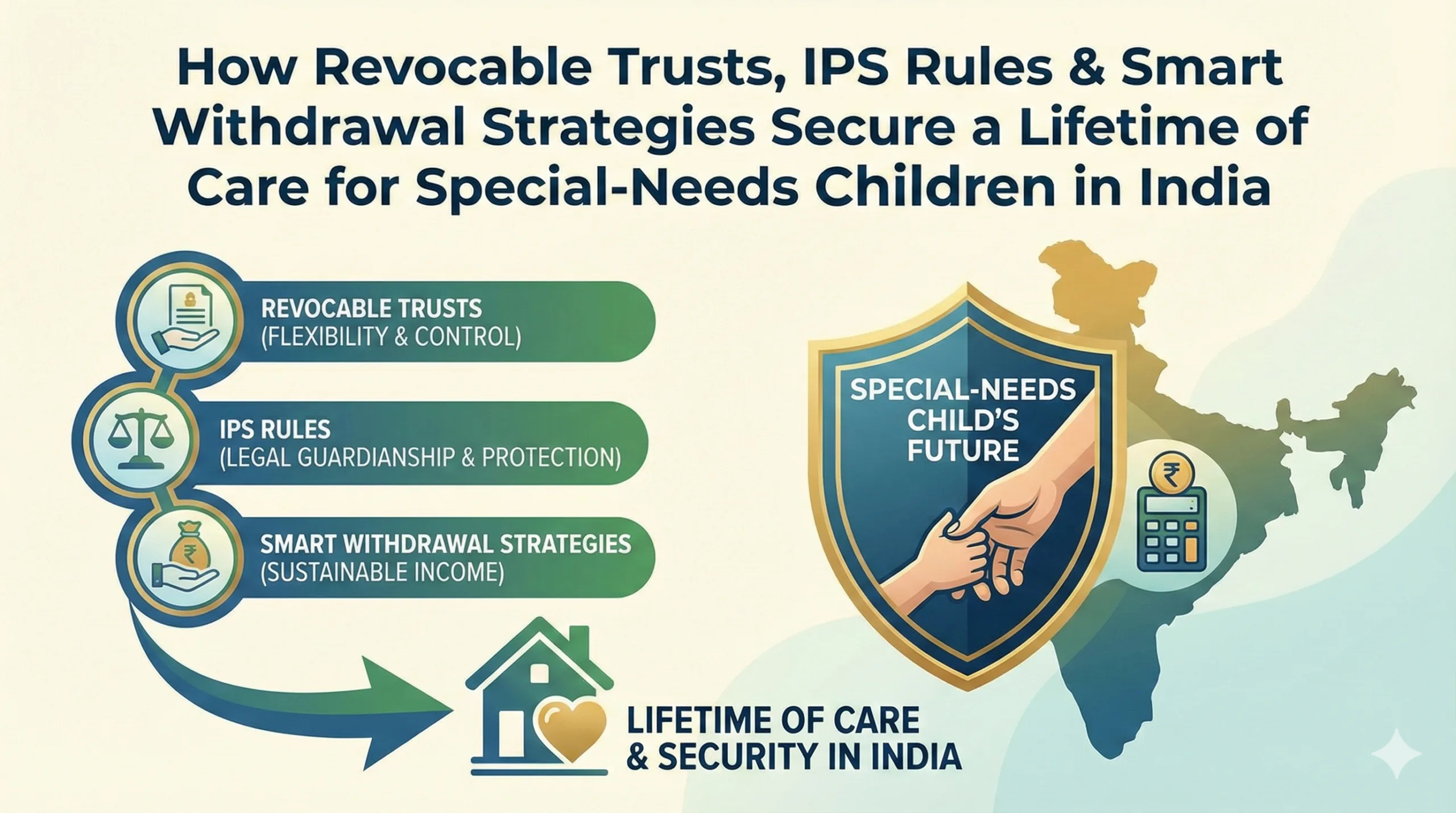
Revocable trusts, IPS discipline, conservative asset allocation, and smart withdrawal rules together build that foundation.
This is not planning.
This is protection.
This is responsibility.
This is love, written legally and financially.
And if this piece resonates with you — perhaps it is time to begin a conversation.
I am here to help.
Disclaimer: The views expressed are for educational purposes only and do not constitute financial, investment, tax, or legal advice. Please consult qualified professionals before making decisions. Mutual fund investments are subject to market risks.
👉 Full Disclaimer | Disclosures | Terms of Use
| 👉Join my FAN page at: | facebook.com/CFPTareshBhatia |
| 👉Follow on Facebook: | facebook.com/TareshBhatiaCFPro |
| 👉Follow me on Instagram: | instagram.com/tareshbhatiacfp |
| 👉Follow me on Threads: | threads.net/@tareshbhatiacfp |
| 👉Follow me on Twitter: | twitter.com/tareshbhatiacfp |
| 👉Follow me on LinkedIn: | linkedin.com/in/tareshbhatiacfp |
| 👉Visit Website: | tareshbhatia.com |
| 👉Read Blog: | blog.tareshbhatia.com |
| 👉Buy my Book: | pages.razorpay.com/BookTRP |
| 👉Join me on Telegram: | t.me/+v0ewUJQU0wowN2Jl |
| 👉YouTube Channel: | youtube.com/@Taresh-Bhatia |
| 👉Subscribe: | tinyurl.com/SubscTB |
| 👉Join my Academy: | therichnessacademy.com |
| 👉Complimentary Session-Limited Offer: | learn.therichnessacademy.com/web/checkout/686f9d1203ac6c6374689439 |
| 👉WhatsApp message directly: | wa.me/919810127906 |
| 👉Get Ebook: | tinyurl.com/TenEbook |
The author of this article, Taresh Bhatia, is a Certified Financial Planner® and advocate for female empowerment. For more information and personalized financial guidance, please contact taresh@tareshbhatia.com
He has authored an Amazon best seller-“The Richness Principles”. He is the Coach and founder of The Richness Academy, an online coaching courses forum. This article serves educational purposes only and does not constitute financial advice. Consultation with a qualified financial professional is recommended before making any investment decisions. An educational purpose article only and not any advice whatsoever.
©️2025: All Rights Reserved. Taresh Bhatia. Certified Financial Planner®
Subscribe Now for Upcoming Blogs!
[convertkit form=6555951]
📢 Join free live webinar —
Couple Finance Formula™ Register here